How Blister Pack Revolutionizes Modern Manufacturing Process
High Speed Blister Packaging Line
Blister pack has become an important part of modern production lines for the protection and presentation of products in industries such as pharmaceuticals, food and electronics. It involves wrapping items in cavities or pockets made of plastic and sealed with paper, foil or plastic film. It combines convenience, safety and durability to ensure that products are well protected, visually appealing and ready for distribution. When blister packaging is paired with cartons on an integrated production line, the entire process becomes more efficient and streamlined.
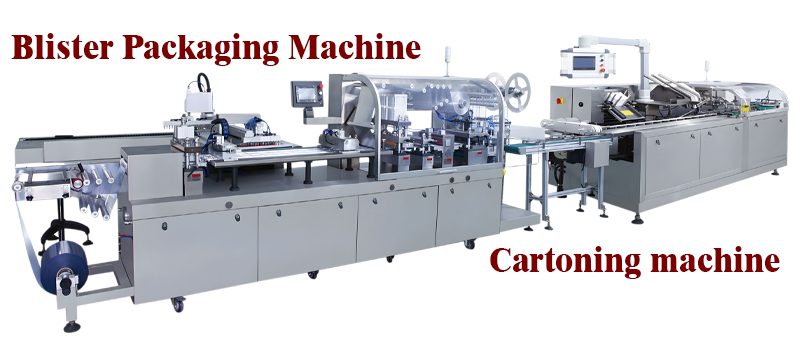
The blister packaging and cartoning linkage line uses advanced automation technology, including servo control, intelligent feeding mechanisms and high-speed synchronization. Quickly adapts to different product sizes, batch requirements and market demands for pharmaceutical products such as capsules, vegetarian tablets, sugar-coated tablets, gelatin pills, shaped tablets, as well as chocolate beans and chewing gum, while reducing waste and downtime. Providing manufacturers with the tools they need to stay competitive in a demanding marketplace.
What is the process of blister molding?
The two common blister molding processes are suction molding and compression molding.
l Blister molding (negative pressure molding). The use of vacuum will be heated and softened film sucked into the molding of the blister into a certain geometric shape, so as to complete the blister molding. Blister molding generally use roller molds, molded blister size is small, simple shape, uneven stretching of the blister, the top is thin.
l Blow molding (positive pressure molding). The use of compressed air will be heated and softened film blown into the mold blister, forming the required geometric shape of the blister. The molded blister wall thickness is more uniform, the shape is quite broad, and can be molded into a large size of the blister, blow molding is mostly used for plate type molds.
Integration of Blister Packaging and Cartoning Machine
Key Features of Cartoning Machine
Cartoning machine is suitable for packaging aluminum-plastic plate block, vials, flexible tubes, can automatically complete the opening of the carton molding, product instruction manual folding, the packaged material discharging and filling, production batch number printing, carton sealing, finished product output and other work, continuous carton conveying method combined with the swing, greatly improving the speed of the product packaging, and at the same time for the blister machine specially designed for the on-line interface, the automation and production efficiency has been greatly improved. The degree of automation and production efficiency is greatly improved.
Advantages of a Linked Blister-Cartoning Line
Integrating blister packaging and cartoning processes into a single production line offers numerous advantages that cater to modern manufacturing demands:
l Efficiency and Speed: The seamless connection between blister packaging and cartoning eliminates intermediate handling, significantly reducing production time. High-speed systems ensure consistent throughput, meeting the demands of large-scale production.
l Enhanced Quality Control: Advanced inspection systems monitor each stage of the process. From verifying the fill level of blister cavities to ensuring proper carton sealing, these systems maintain product integrity and reduce defects.
l Flexibility and Customization: Integrated lines can be quickly adjusted for different product sizes, shapes, and packaging styles. This adaptability makes them ideal for industries with varied product portfolios.
l Cost Savings: Automation reduces the need for manual intervention, lowering labor costs while also minimizing material wastage through precision operations.
l Compact Design: By combining two major processes into a single line, manufacturers can save valuable factory floor space while maintaining high productivity.
Applications of Blister Packaging and Cartoning Line
Integrated lines are used across industries for a wide range of products, including:
The ability to handle diverse products ensures that these lines remain versatile, catering to various market needs.
Blister packaging and cartoning linkage lines represent the pinnacle of modern manufacturing efficiency, providing a streamlined, automated solution for industries that prioritize quality, speed, and adaptability. As technology continues to evolve, these integrated systems will play a crucial role in driving innovation and competitiveness in the packaging sector.